
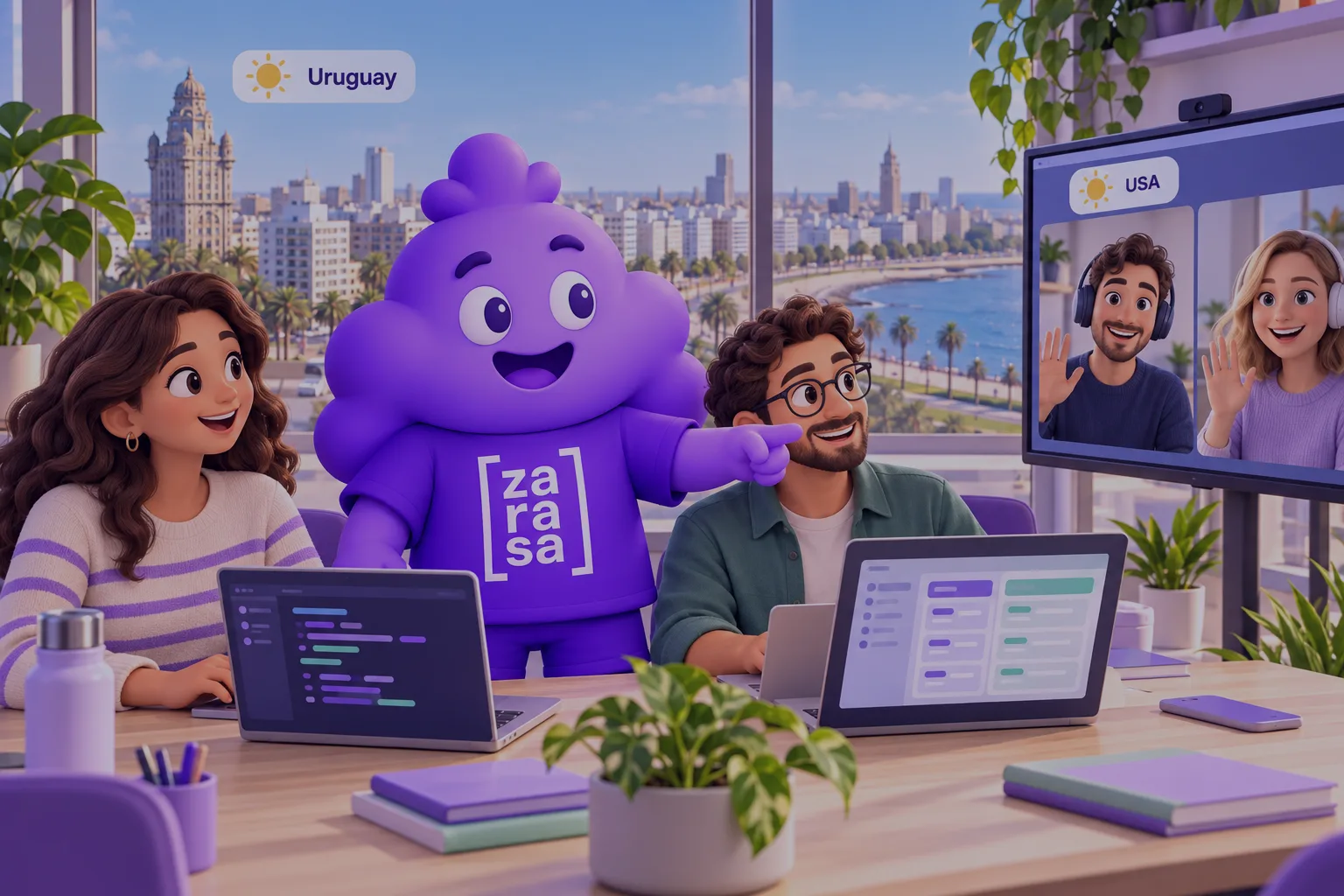

Why Miami companies look to Uruguay for Salesforce work
Most US Salesforce teams are not starting from zero. They already run Sales Cloud or Service Cloud and now need to add Agentforce, Data 360 or Revenue Cloud. In the fiscal fourth quarter of 2026 (November 2025 to January 2026), more than 60% of Agentforce and Data 360 bookings came from existing customers expanding what they had, according to Salesforce.
That work needs certified people who can join your sprint this week, not a six-month recruiting cycle. For companies in Miami, Uruguay has become one of the first places to look. The United States already buys 77.6% of everything the Uruguayan IT industry exports (CUTI, via La Mañana), and Montevideo shares most of Miami's working day.
This guide covers the five reasons behind that choice, with the data for each: time zone, talent, cost, stability and infrastructure. It then looks at what Miami adds on top, and ends with how to engage a nearshore Salesforce team.
1. Your workday in Miami is their workday
Uruguay sits at UTC−3 all year. It stopped observing daylight saving time in 2015 (Wikipedia). For a team in Miami or New York, that means Montevideo is 1 hour ahead in summer and 2 hours ahead in winter.
| US time zone | Difference, US summer | Difference, US winter | A 9:00 am – 6:00 pm day in Montevideo, in your time |
|---|---|---|---|
| Eastern (Miami, New York) | +1 h | +2 h | 8:00 am – 5:00 pm (summer) · 7:00 am – 4:00 pm (winter) |
| Central (Chicago, Dallas) | +2 h | +3 h | 7:00 am – 4:00 pm · 6:00 am – 3:00 pm |
| Mountain (Denver) | +3 h | +4 h | 6:00 am – 3:00 pm · 5:00 am – 2:00 pm |
| Pacific (San Francisco, Seattle) | +4 h | +5 h | 5:00 am – 2:00 pm · 4:00 am – 1:00 pm |
- Eastern (Miami, New York)Difference, US summer+1 hDifference, US winter+2 hA 9:00 am – 6:00 pm day in Montevideo, in your time8:00 am – 5:00 pm (summer) · 7:00 am – 4:00 pm (winter)
- Central (Chicago, Dallas)Difference, US summer+2 hDifference, US winter+3 hA 9:00 am – 6:00 pm day in Montevideo, in your time7:00 am – 4:00 pm · 6:00 am – 3:00 pm
- Mountain (Denver)Difference, US summer+3 hDifference, US winter+4 hA 9:00 am – 6:00 pm day in Montevideo, in your time6:00 am – 3:00 pm · 5:00 am – 2:00 pm
- Pacific (San Francisco, Seattle)Difference, US summer+4 hDifference, US winter+5 hA 9:00 am – 6:00 pm day in Montevideo, in your time5:00 am – 2:00 pm · 4:00 am – 1:00 pm
In practice, a team in Uruguay joins your stand-up, your sprint review and your production incidents in real time. With offshore teams 9 to 12 hours away, the same conversation waits until the next morning. For Salesforce work, where admins, developers and business users iterate on the same org every day, that delay adds up fast.
From Miami there is one more advantage: distance. American Airlines flies Miami–Montevideo nonstop once a day, an overnight flight of about nine hours (FlightConnections). You leave MIA at night and land in Montevideo the next morning, on the same clock.
2. A talent pool built for export
The Uruguayan tech industry was built to sell abroad. In 2024 it billed US$3.681 billion, 4.5% of GDP, and 63% of that came from foreign clients. Of those exports, 77.6% went to the United States, ahead of the United Kingdom at 9.8% (CUTI and Central Bank of Uruguay, via La Mañana). About 550 tech companies operate in the country, and 74% of them export.
That means engineers in Uruguay are used to US clients: US documentation standards, US security reviews, US product managers on the call.
English. Uruguay scored 542 on the EF English Proficiency Index 2025, ranking 34th of 123 countries and regions, well above the global average of 488. It gained 44 points over the previous edition (EF EPI).
Digital education from childhood. In 2007, Plan Ceibal made Uruguay the first country to give a laptop to every student and teacher in public schools nationwide (ICTworks). The first Ceibal generation is now in its late twenties and in the workforce.
One honest point: demand for tech talent in Uruguay is high, and the sector has reported a shortage of qualified workers (Nearshore Americas). That is why working with an established partner that already has certified people on staff is faster than recruiting on your own.
3. 40% to 60% lower cost, same certifications
A certified Salesforce developer in the US bills US$90 to US$180 an hour. In Latin America, the same profile bills US$35 to US$70, a saving of 40% to 60% (Zarasa). The certifications are identical: Salesforce issues the same credentials everywhere.
| Market reference | United States | Uruguay / Latin America |
|---|---|---|
| Salesforce developer, hourly rate | US$90–180 | US$35–70 (Latin America) |
| Software developer, annual compensation | US$110,000–180,000+ | US$40,000–85,000 (Uruguay) |
| Senior engineer, savings vs US | — | 60%–65% (Latin America) |
- Salesforce developer, hourly rateUnited StatesUS$90–180Uruguay / Latin AmericaUS$35–70 (Latin America)
- Software developer, annual compensationUnited StatesUS$110,000–180,000+Uruguay / Latin AmericaUS$40,000–85,000 (Uruguay)
- Senior engineer, savings vs USUnited States—Uruguay / Latin America60%–65% (Latin America)
Sources: Zarasa, South, BEON.tech.
Uruguay is not the lowest-cost country in the region. Its rates sit in the middle of the Latin American range. What US companies pay for is lower risk: fewer handoffs lost to time zones, strong English and a legal system they can rely on. The next section covers that.
These figures are market references, not a price list. At Zarasa we price by project or by retainer, and we give an estimate after a diagnostic session, once we know what the work actually is.
4. Stability and data protection you can put in a contract
Low corruption. Uruguay scored 73 out of 100 on the Transparency International Corruption Perceptions Index 2025. It ranks second in the Americas, behind only Canada (75), and above the United States (64). The regional average is 42 (Transparency International).
Data protection recognized by the EU. The Uruguayan Personal Data Protection Law (Law 18.331, 2008) was found adequate by the European Commission on 21 August 2012. Personal data can flow from the EU to Uruguay without extra safeguards (Inside Privacy). For a Miami company with European customers in its Salesforce org, that removes a compliance question before it is asked.
Institutional strength. The same Transparency International report describes Uruguay and Costa Rica as the region's strongest democracies. For a multi-year engagement, that matters as much as the hourly rate.
5. Infrastructure that keeps teams online
Fiber nearly everywhere. In 2026 the state carrier Antel finished bringing fiber optic to every town in Uruguay with more than 1,000 residents (Presidency of Uruguay). About 96% of the population has access to fiber networks (Telecompaper). Remote consultants can join video calls and long deployment sessions without connection issues.
A mature services economy. Software services are among the five largest exports of Uruguay (Uruguay XXI). IT services exports reached US$1.349 billion in 2025, 18.3% of all services the country sells abroad (CUTI and Central Bank of Uruguay, via La Mañana). Uruguay XXI, the government export agency, lists finance, health, logistics, retail and education as the verticals growing fastest.
What Miami adds on top
Miami is where many US companies run Latin America from. According to the Miami-Dade Beacon Council, 1,200 multinational companies have set up their Latin American headquarters in Miami-Dade County. Those teams usually work in two languages and manage operations spread across several countries.
A team in Montevideo fits that setup. It works in English and Spanish, so documentation can run in one language and the working sessions in the other. It already understands how a regional rollout differs from a single-country one. And when the project needs people in the room, it is one overnight flight, not a different continent.
Zarasa has its headquarters at 1000 Brickell Ave, Miami, and an office in Montevideo, so the same company is on both ends of that flight. More about our presence in the city on the Salesforce consultant in Miami page.
How to work with a nearshore Salesforce team in Uruguay
The market offers three common models. Pick the one that matches how much your own team will direct the work.
| Model | Best for | Who directs the work | Typical commitment |
|---|---|---|---|
| Staff augmentation | Adding 1–3 people to your existing team that you will manage yourself | You: tasks, priorities and outcome. The provider handles hiring | Monthly, by hours or full time |
| Dedicated nearshore team | An ongoing roadmap: releases, integrations, Agentforce use cases | You own the backlog; the partner manages the team and the delivery | 6–12 months, renewable |
| Fixed-scope project | A defined outcome: a Sales Cloud rollout, a CPQ to Revenue Cloud migration | You set the acceptance criteria; the partner delivers | By project |
- Staff augmentationBest forAdding 1–3 people to your existing team that you will manage yourselfWho directs the workYou: tasks, priorities and outcome. The provider handles hiringTypical commitmentMonthly, by hours or full time
- Dedicated nearshore teamBest forAn ongoing roadmap: releases, integrations, Agentforce use casesWho directs the workYou own the backlog; the partner manages the team and the deliveryTypical commitment6–12 months, renewable
- Fixed-scope projectBest forA defined outcome: a Sales Cloud rollout, a CPQ to Revenue Cloud migrationWho directs the workYou set the acceptance criteria; the partner deliversTypical commitmentBy project
Staff augmentation is a legitimate model, but it is not ours. Zarasa works with its own in-house team and takes responsibility for the delivery, as a dedicated team or by project, rather than placing profiles for you to manage. The practical difference is continuity: what the team learns on one project stays in the house. We explain the full comparison in in-house team vs IT staffing.
Before you sign, check: Salesforce certifications per person (verifiable on Trailhead), verified reviews on AppExchange, overlap with your working hours, who owns the code and the data, whether the partner can invoice from the US, and whether it has a presence there you can meet in person.
Working with Zarasa
Zarasa is a registered Salesforce partner that has implemented Salesforce since 2020, with 78 Salesforce certifications across the team, more than 120 delivered projects and a 4.86 out of 5 rating from 20 verified reviews on AppExchange. We work from four offices of our own in Miami, Mexico City, Mixco and Montevideo, in English and Spanish, inside US business hours, and we invoice from the United States.
Nearshore Salesforce delivery, from Miami and Montevideo
See how we structure an engagement, the projects we have delivered for US companies, and what the first 45-minute conversation covers.
Nearshore Salesforce development →Frequently asked questions
What is the time difference between Miami and Uruguay?
Uruguay is on UTC−3 all year. It is 1 hour ahead of Miami (US Eastern time) in summer and 2 hours ahead in winter, so a full workday overlaps with the East Coast.
How far is Montevideo from Miami?
American Airlines flies Miami–Montevideo nonstop once a day, an overnight flight of about nine hours. You leave Miami at night and land in Montevideo the next morning.
How much does a Salesforce developer in Uruguay cost?
Certified Salesforce developers in Latin America bill about US$35 to US$70 an hour, compared with US$90 to US$180 in the US. Exact rates depend on seniority and certifications. Zarasa prices by project or retainer after a diagnostic session.
Do developers in Uruguay speak English?
Uruguay ranks 34th of 123 countries and regions on the EF English Proficiency Index 2025, with a score of 542, above the global average of 488.
Is it safe to share customer data with a team in Uruguay?
The Uruguayan data protection law has been recognized as adequate by the European Commission since 2012, and the country ranks second in the Americas on the Transparency International 2025 corruption index.
Does Zarasa offer staff augmentation?
No. Zarasa works with its own in-house team and takes responsibility for the delivery, as a dedicated team or by project. With staff augmentation, you direct the people yourself; that is a different model and a different kind of provider.
Are Salesforce certifications from Uruguay the same as in the US?
Yes. Salesforce issues the same certifications worldwide, and each one can be verified on Trailhead.
Sources
- Salesforce: fourth quarter fiscal 2026 results
- La Mañana: CUTI and Central Bank data on the Uruguayan IT sector
- Uruguay XXI: software development
- Wikipedia: daylight saving time in Uruguay
- FlightConnections: nonstop flights from Miami to Montevideo
- Miami-Dade Beacon Council: a global-first market
- EF English Proficiency Index: Uruguay
- ICTworks: Plan Ceibal
- Nearshore Americas: talent shortage in Uruguay
- Zarasa: Salesforce in LATAM vs the US
- South: developer rates by country
- BEON.tech: nearshore development rates 2026
- Transparency International: CPI 2025, the Americas
- Inside Privacy: EU adequacy decision for Uruguay
- Presidency of Uruguay: Antel fiber coverage
- Telecompaper: Antel fibre rollout