

Licenses cost the same; everything else doesn't
Let's clear up the most common myth first: there is no cheaper "Latin American license." The official Sales Cloud price list (checked August 2026) is global and in US dollars: Starter USD 25, Pro Suite USD 100, Enterprise USD 175, Unlimited USD 350 and Agentforce 1 Sales USD 550 per user per month, billed annually.
For a 20-user SMB on Enterprise, that is USD 42,000 a year in licenses, whether you are in Texas or Guatemala. The real difference between the two markets is not the license: it is what it costs to get it working, and how heavy that investment feels. We broke this down in our guide to how much Salesforce costs in LATAM; now we compare it against the US market.
Implementation: the same project at half the price
Here is the first big gap. According to a 2026 US rate guide, a mid-level consultant charges USD 100–250 per hour, a developer runs USD 130–350 depending on the type of firm, and a senior architect USD 200–500+. At those rates, a simple QuickStart costs USD 10,000–25,000, a standard implementation USD 25,000–75,000 and a mid-market project USD 75,000–150,000.
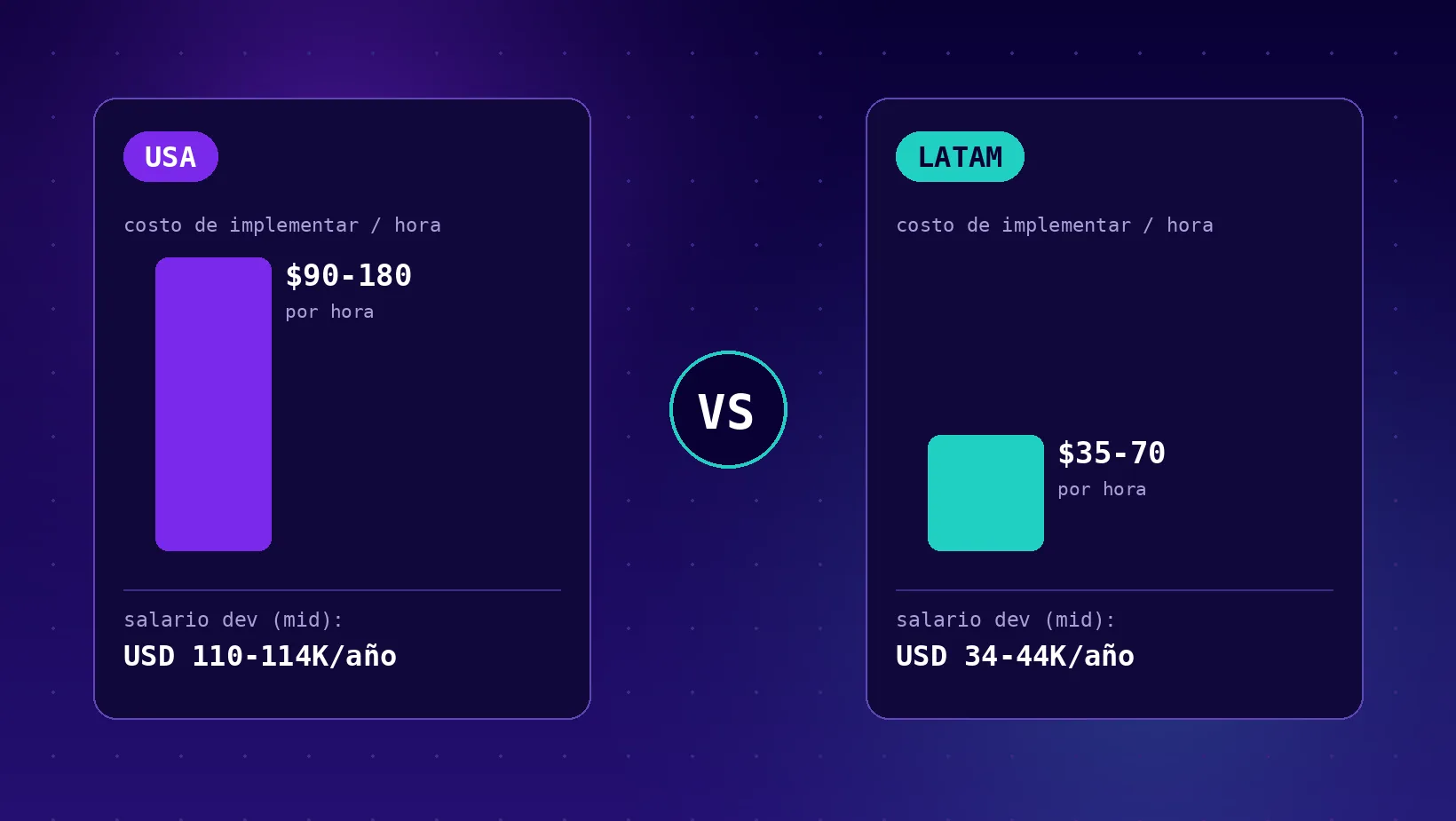
Latin American teams do the same work at USD 35–70 per hour, versus USD 90–180 for a US-based Salesforce developer, according to an April 2026 comparison. That same analysis puts total savings at 40–60% and translates it into money: a five-person team over one year saves USD 300,000–600,000 in a nearshore model.
Salaries: the gap that explains everything above
Rates are lower because salaries are different. The Salesforce Ben 2024–25 salary survey (3,500 respondents across 95 countries) puts the US Salesforce developer at USD 78,066 (junior), 109,580 (mid) and 165,543 (senior) in annual base salary. For the region, an April 2025 guide surveys mid-level pay as follows:
- United States: USD 114,000 per year
- Argentina: USD 43,800 per year
- Colombia: USD 41,500 per year
- Mexico: USD 38,400 per year
- Brazil: USD 34,200 per year
A mid-level developer in Mexico or Brazil costs roughly a third of their US counterpart, holds the same official Salesforce certifications and — unlike other outsourcing destinations — works in the same time zone as the North American client. That combination is what powers the nearshore boom below.
Where the demand that hires teams actually is
Salesforce closed fiscal year 2025 with USD 37.9 billion in global revenue (+9%) and was named by IDC the world's #1 CRM for the thirteenth consecutive year, with a 20.0% share in 2025 (April 2026 report). The United States accounts for most of that revenue, and therefore for most of the projects that need people.
What matters when you are staffing a team is not what the industry is worth but how fast new projects appear. In South America, CRM has been growing at almost 12% a year, close to double the global pace, and that growth turns into implementations someone has to staff. The region is not lagging on AI maturity either: according to IDC's CIO Playbook 2026 (April 2026), 97% of Latin American organizations plan to increase their AI budget over the next 12 months, with Brazil (67%), Argentina (66%) and Mexico (65%) already in systematic adoption.
The practical consequence works both ways: there is demand on both sides of the map, and the team serving it can sit on either. That is precisely what makes a project cheaper without lowering the bar.
Four dated trends shaping the field
- Salesforce put USD 1 billion into the region (October 2025). The company announced a USD 1 billion, five-year investment in Mexico and, a month later, opened its largest Latin American office in Mexico City: 192,000 square feet with capacity for 2,000 employees, home to its second-largest Global Delivery Center worldwide.
- The agentic era already generates revenue (Q3 FY26). Agentforce passed USD 500 million in ARR, growing 330% year over year, with 18,500 deals closed since launch. Regional users already include Globo (Brazil), Grupo Falabella (Chile) and Protección (Colombia).
- Nearshore is no longer plan B. With the salary gap above and the shared time zone, LATAM teams went from "cheaper alternative" to first choice for US companies; documented savings range from 30–50% to 40–60% depending on the source (2026).
- The ecosystem creates jobs at scale (2022–2028). IDC projects the AI-powered Salesforce economy will create 11.6 million jobs and USD 2.02 trillion in customer revenues between 2022 and 2028 (September 2023 study). Certified talent is scarce everywhere — and that is a huge card for LATAM to play.
What this means if your company is in LATAM (or sells to the US)
For a Latin American company the takeaway is twofold. First: the license is paid in dollars at the global list price, so the project gets cheaper on the implementation side — choosing the right scope and partner matters more here than in the United States. Second: the regional market is growing at almost 12% a year and Salesforce is investing seriously in the region, which means the ecosystem (talent, support, local case studies) will keep maturing.
The bottom line: in the United States, Salesforce is a mature market where you compete on efficiency. In Latin America it is an expanding market where whoever implements well and early takes the lead — at a fraction of the project cost a North American company pays.
And looking from the north, the conclusion mirrors it: the same project, with certified talent in your time zone, costs 40–60% less when the team is in the region.
How Zarasa can help
We are a Salesforce consulting partner with a presence in Miami and teams across Latin America: we live in both markets this article compares. We can help you scope a project at regional rates, or build a certified nearshore team if your operation is in the United States. The first conversation is free.
Want to know what your project would cost at regional rates?
We will build you a concrete estimate of scope, timeline and cost — no strings attached.
Let's talk about your caseFrequently asked questions
Is the Salesforce license cheaper in Latin America?
No. The price list is global and in US dollars: Starter USD 25, Pro Suite USD 100, Enterprise USD 175, Unlimited USD 350 and Agentforce 1 Sales USD 550 per user per month (August 2026). What does change in the region is the cost of implementation and talent, which can be 30–60% lower.
How much does a Salesforce implementation cost?
At US rates, a simple quick start runs USD 10,000–25,000, a standard implementation USD 25,000–75,000 and a mid-market project USD 75,000–150,000 (2026 data). With a Latin American partner, hourly rates drop from USD 90–180 to USD 35–70. The full breakdown is in our guide to Salesforce costs in LATAM.
Does it make sense to hire a LATAM partner if my company is in the US?
That is the nearshore thesis: same time zone, 30–60% savings on rates and Salesforce-certified talent. An April 2026 analysis estimates savings of USD 300,000–600,000 per year for a five-person team.
Is the Salesforce market growing faster in LATAM than in the US?
South America's CRM market is projected to grow 11.97% annually through 2035, above Salesforce's global growth (9% in FY25). Salesforce also announced in October 2025 a USD 1 billion investment in Mexico, its largest ever in the region.