
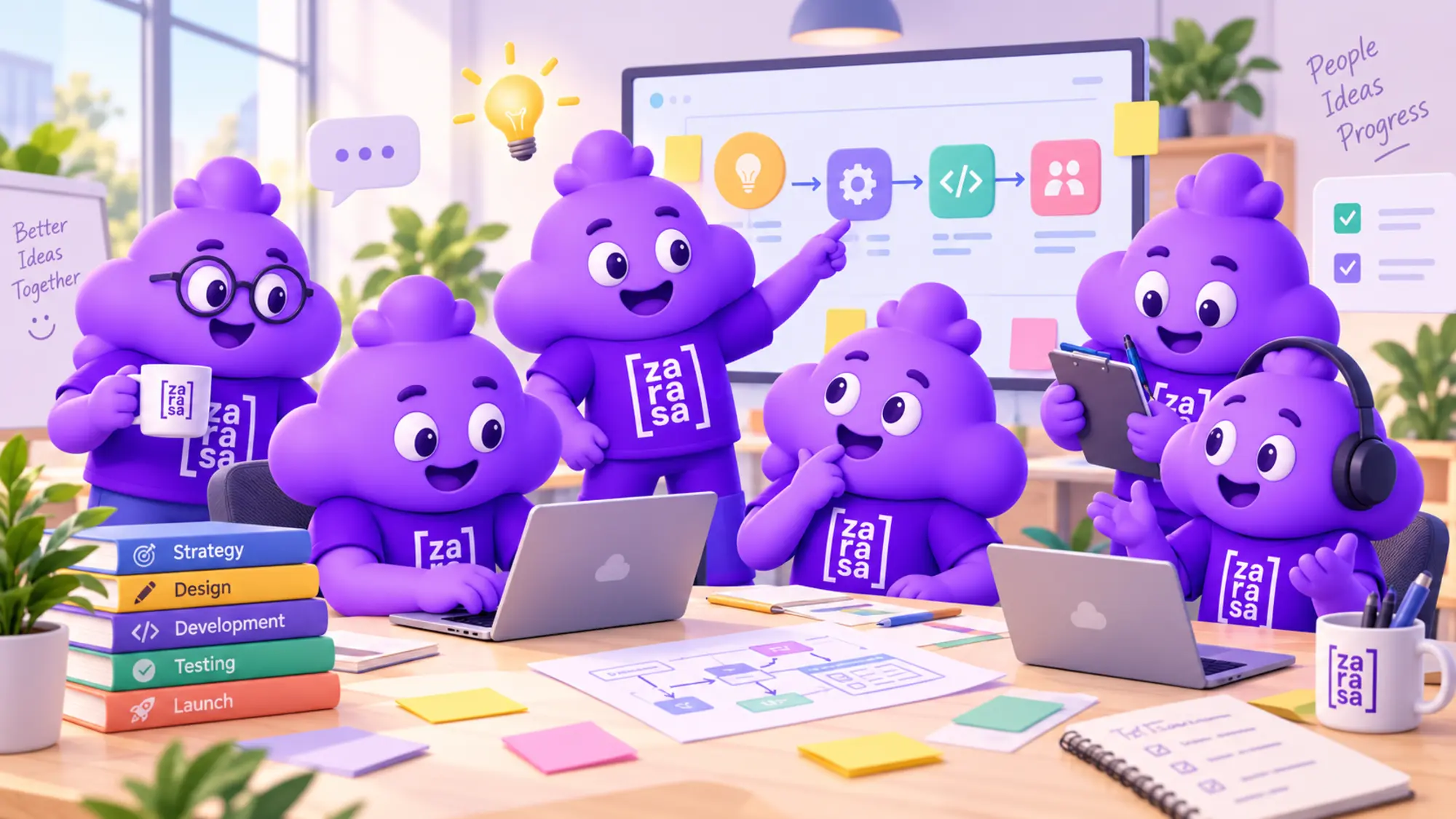
From an HR perspective, a team is a group of people with complementary skills working toward a shared goal.
Behind every project there is a group of people who turn ideas and needs into working solutions. It would be easy to assume that solving each task is just a matter of finding someone with the right knowledge. In practice it is considerably more complex.
Teams get their strength from the people in them and from the way those people work together. Technical experience is essential, but so are trust, communication, a shared culture and the ability to learn and adapt.
The in-house team model
At Zarasa we chose to work with our own staff, people who share and build the same working culture over time.
This model lets us think about people's development beyond the specific needs of any one project. Through career plans we work to keep broadening our teams' knowledge, supporting their growth and the demands of a technology ecosystem that never stops changing.
Reviewing training needs on a regular basis helps us spot new learning opportunities and strengthen what the team can do. In an environment like Salesforce, where new tools and features keep appearing, staying current is a core part of the job.
But development is not only individual. We also work on collective knowledge, so that what one person learns can be shared and become knowledge for the whole team.
On top of that, our model has a challenge of its own: bringing together teams that work from different countries and often do not share a physical space. That is why creating moments to meet and connect is part of how we work. As we described in A Team Without Borders, those moments are there to strengthen the bonds and keep a shared culture alive, whatever the distance.
How does this model affect projects?
Working with an in-house team brings benefits that go beyond assigning professionals to a project.
One of them is continuity of knowledge. When people stay within the same structure and build experience cumulatively, what they learn on one project becomes learning for future challenges, inside and outside that project.
It also builds greater alignment in culture and ways of working, both within the team and in the relationship with clients. Over time, knowing each client's dynamics, needs and communication style makes for a closer relationship and easier collaboration.
A stable team also helps build long-term relationships. The project stops being a one-off allocation of resources and starts resting on a relationship between people who know each other, understand the context and share the same goals.
What an in-house team brings
- Continuity of knowledge. What is learned on one project stays in the house and serves the next one.
- Cultural alignment. One way of working inside the team and in the relationship with each client.
- Long-term relationships. The project rests on people who already know each other and understand the context.
Of course, no model is free of challenges. One of them is that a permanent team does not necessarily have, from day one, specialists in every area or technology a project may call for. For us that is an opportunity to keep building capability: ongoing training, bringing in new profiles and sharing knowledge within the team let us gradually widen what we can take on and respond to new needs.
What other ways of building a team are there?
The permanent team model is one option among several ways of bringing technology talent onto a project.
IT staffing, or staff augmentation
External professionals join the client's existing team to work on specific projects or needs. Under this arrangement, project direction and planning usually stay with the client, while the provider handles recruitment, hiring and regulatory compliance.
Its main strength is flexibility and fast access to specialised talent. At the same time, depending on how the integration is managed, it can bring challenges around continuity of knowledge or turnover of professionals.
Teams assembled for each project
The company implementing the solution handles both hiring and directing the team, bringing in professionals according to the particular needs of each initiative.
This model makes it quick to adapt the size and make-up of the team and to add specialised profiles project by project. On the other hand, there can be less continuity of knowledge once the initiative ends, along with more turnover of professionals between projects.
Why we chose this model
There is no single right model for every project or every organisation. The choice depends on factors such as the knowledge required, the timelines, how much flexibility is needed and the kind of relationship you want to build with the client.
At Zarasa we chose to work with an in-house team because we believe a technology project is not built on technical knowledge alone: it is built with people. People who know their work, who can keep developing, who share what they know and who build relationships of trust with their colleagues and with our clients. So what we set out to build are teams capable of learning from every experience.
Frequently asked questions
What is the in-house team model?
It means working with our own staff, people who share and build the same working culture over time. It lets us think about people's development beyond the needs of any one project, through career plans that keep broadening the team's knowledge.
What does an in-house team bring to a project?
Continuity of knowledge, because what is learned on one project stays in the house and serves the next one. Cultural alignment, meaning one way of working inside the team and with each client. And long-term relationships, because the project rests on people who already know each other.
What is IT staffing or staff augmentation?
External professionals join the client's existing team to work on specific projects or needs. Project direction and planning usually stay with the client, while the provider handles recruitment, hiring and regulatory compliance. Its main strength is flexibility.
What about teams assembled for each project?
There, the company implementing the solution handles both hiring and directing the team, bringing in professionals according to the needs of each initiative. It makes it quick to adapt the size and make-up of the team and to add specialised profiles project by project.
Which model is the right one?
There is no single right model for every project or every organisation. The choice depends on the knowledge required, the timelines, how much flexibility is needed and the kind of relationship you want to build with the client.
Looking for a partner with an in-house team?
The same people from start to finish, carrying the context of your project. Free 45-minute assessment.
Book a free assessment →