
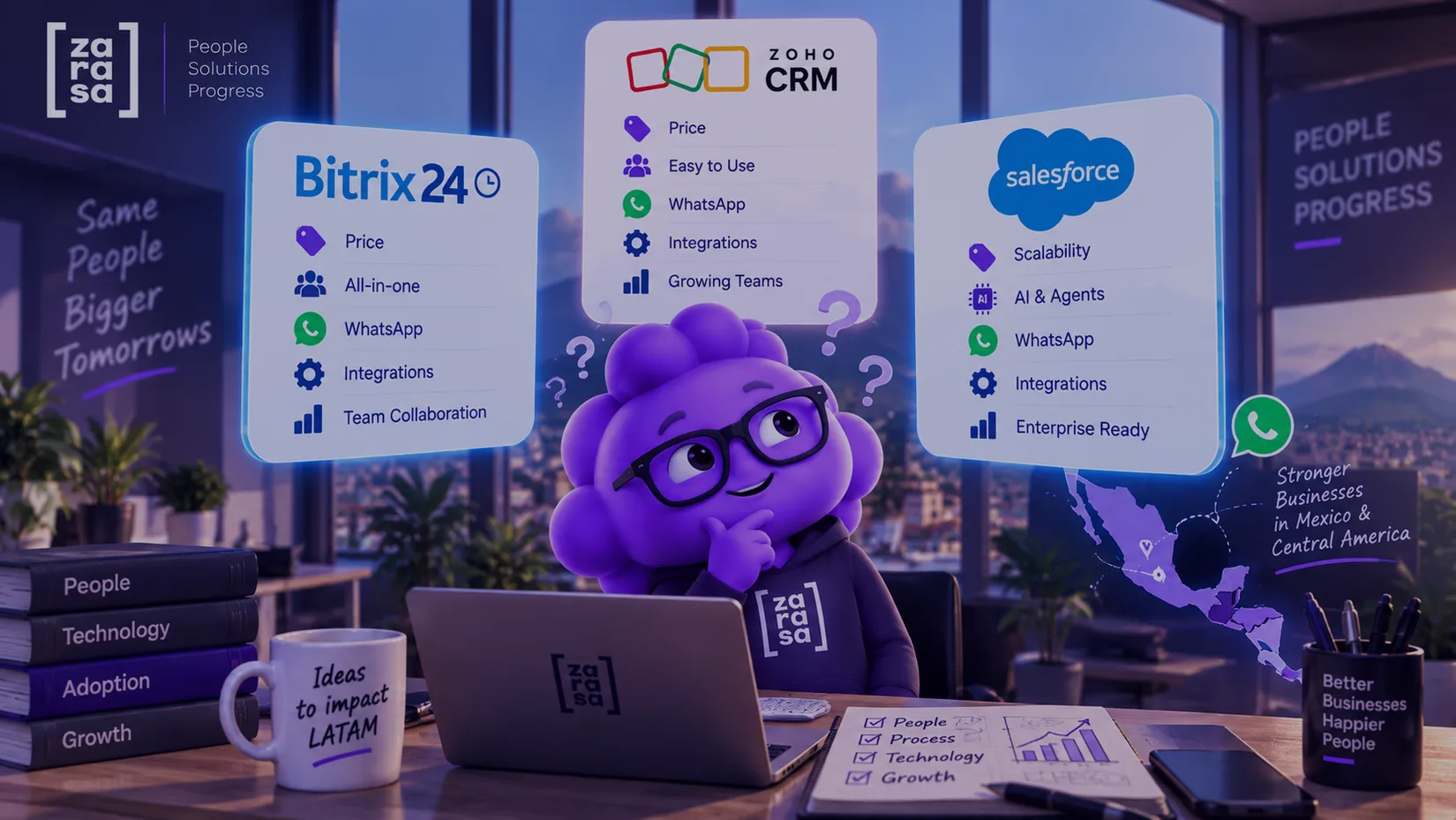

If you sell in Mexico or Central America and you are choosing a CRM, sooner or later these three names land on the table. Bitrix24 comes up because it is cheap and ships with everything; Zoho because it charges little per user and has an office in Querétaro; Salesforce because it leads the market and someone on your board has used it before. All three are good products. The problem is that most comparisons you will find are written by resellers of one of them, and we are one of those: Zarasa is a Salesforce Consulting Partner. We say it up front so you read what follows with that lens on.
What we try to do here is different: put the official September 2026 prices side by side, work out what each one costs for teams of 10, 30 and 100 salespeople, and say, with documented evidence, where each one wins and where it loses. Every figure links to its source. Where we could not confirm something, we say so.
Three pricing models, not three prices
Before looking at numbers it helps to understand that they do not charge the same way, and that explains most of the differences.
Bitrix24 charges per plan, with users included. The Standard plan costs the same whether you have 12 users or 50. It is a full suite (CRM, tasks, chat, video calls, website builder) and the CRM is one part of it.
Zoho CRM charges per user, per edition. The classic model: pick an edition, pay per seat. The rest of the Zoho suite (invoicing, marketing, support) is bought separately or through the Zoho One bundle.
Salesforce Sales Cloud charges per user, per edition, and changed its editions on September 3, 2026. Enterprise, Unlimited and Agentforce 1 Sales were replaced by Core, Advanced and Max, which bundle AI credits, Slack and Tableau Next into the price. If a comparison still quotes Enterprise at US$175, it is out of date.
Official prices, September 2026
List prices in US dollars, taken from each vendor's official pricing page on September 22, 2026. Annual billing unless stated; local taxes are extra in all three cases. None of the three publishes negotiated prices or volume discounts, which do exist.
| Bitrix24 (per plan) | Monthly (annual billing) | Users included | Storage |
|---|---|---|---|
| Free | US$0 | up to 2 | 5 GB |
| Basic | US$49 (US$69 month to month) | 5 | 24 GB |
| Standard | US$99 (US$144 month to month) | 50 | 100 GB |
| Professional | US$199 (US$289 month to month) | 100 | 1 TB |
| Enterprise | from US$399 (from US$579 month to month) | 250 to 10,000+ | 3 to 30 TB |
- FreeMonthly (annual billing)US$0Users includedup to 2Storage5 GB
- BasicMonthly (annual billing)US$49 (US$69 month to month)Users included5Storage24 GB
- StandardMonthly (annual billing)US$99 (US$144 month to month)Users included50Storage100 GB
- ProfessionalMonthly (annual billing)US$199 (US$289 month to month)Users included100Storage1 TB
- EnterpriseMonthly (annual billing)from US$399 (from US$579 month to month)Users included250 to 10,000+Storage3 to 30 TB
Source: bitrix24.com/prices. The Mexican site lists the same plans in pesos: Basic MX$999, Standard MX$1,999 and Professional MX$3,999 per month on annual billing (bitrix24.mx/prices).
| Zoho CRM (per user) | US$/user/month, annual | US$/user/month, monthly |
|---|---|---|
| Free | US$0 (up to 3 users) | US$0 |
| Standard | US$14 | US$20 |
| Professional | US$23 | US$35 |
| Enterprise | US$40 | US$50 |
| Ultimate | US$52 | US$65 |
- FreeUS$/user/month, annualUS$0 (up to 3 users)US$/user/month, monthlyUS$0
- StandardUS$/user/month, annualUS$14US$/user/month, monthlyUS$20
- ProfessionalUS$/user/month, annualUS$23US$/user/month, monthlyUS$35
- EnterpriseUS$/user/month, annualUS$40US$/user/month, monthlyUS$50
- UltimateUS$/user/month, annualUS$52US$/user/month, monthlyUS$65
Source: Zoho CRM official edition comparison. Zoho does not publish Mexican peso prices; its regional page notes that VAT is charged on top.
| Salesforce Sales Cloud (per user) | US$/user/month | Billing | Flex AI credits included per year |
|---|---|---|---|
| Free Suite | US$0 | — | — |
| Starter Suite | US$25 | monthly or annual | — |
| Pro Suite | US$100 | annual | — |
| Core (was Enterprise, US$175) | US$195 | annual | 500,000 |
| Advanced (was Unlimited, US$350) | US$395 | annual | 1,000,000 |
| Max (was Agentforce 1 Sales) | US$550 | annual | 2,750,000 |
- Free SuiteUS$/user/monthUS$0Billing—Flex AI credits included per year—
- Starter SuiteUS$/user/monthUS$25Billingmonthly or annualFlex AI credits included per year—
- Pro SuiteUS$/user/monthUS$100BillingannualFlex AI credits included per year—
- Core (was Enterprise, US$175)US$/user/monthUS$195BillingannualFlex AI credits included per year500,000
- Advanced (was Unlimited, US$350)US$/user/monthUS$395BillingannualFlex AI credits included per year1,000,000
- Max (was Agentforce 1 Sales)US$/user/monthUS$550BillingannualFlex AI credits included per year2,750,000
Source: salesforce.com/mx/sales/pricing, which shows US dollar prices for Mexico. The September 3, 2026 edition change and the previous prices are in Salesforce's 2025 pricing announcement and in Salesforce Ben's coverage. We explain what a Flex credit is in Agentforce pricing: Flex Credits and real cost.
What it costs for 10, 30 and 100 salespeople
This is the sum every sales director does, so we do it with the lists above: monthly cost on annual billing, licenses only, no taxes or discounts. For Bitrix24 we take the smallest plan that covers the headcount; for Zoho and Salesforce, the mid edition most SMBs end up buying (Zoho Professional, Salesforce Pro Suite) and the edition that includes AI.
| Team | Bitrix24 | Zoho Professional | Zoho Enterprise | Salesforce Pro Suite | Salesforce Core |
|---|---|---|---|---|---|
| 10 users | US$99 (Standard) | US$230 | US$400 | US$1,000 | US$1,950 |
| 30 users | US$99 (Standard) | US$690 | US$1,200 | US$3,000 | US$5,850 |
| 100 users | US$199 (Professional) | US$2,300 | US$4,000 | US$10,000 | US$19,500 |
- 10 usersBitrix24US$99 (Standard)Zoho ProfessionalUS$230Zoho EnterpriseUS$400Salesforce Pro SuiteUS$1,000Salesforce CoreUS$1,950
- 30 usersBitrix24US$99 (Standard)Zoho ProfessionalUS$690Zoho EnterpriseUS$1,200Salesforce Pro SuiteUS$3,000Salesforce CoreUS$5,850
- 100 usersBitrix24US$199 (Professional)Zoho ProfessionalUS$2,300Zoho EnterpriseUS$4,000Salesforce Pro SuiteUS$10,000Salesforce CoreUS$19,500
The gap between the extremes is an order of magnitude, and there is no way to soften it: on licenses, Bitrix24 costs between 10 and 100 times less than Salesforce Core. The right question is not whether that gap exists but what each dollar buys. That is what follows.
Artificial intelligence: what each edition includes
Bitrix24 includes CoPilot from the Basic plan. The documented limit is 600 requests per hour for the whole account, on every plan (help center); the product page itself says that "some CoPilot features are free, but advanced functionality may require a commercial plan or pay-as-you-go credits". Per-plan quotas are not published.
Zoho CRM reserves Zia, its assistant, for the Enterprise and Ultimate editions. In the official comparison table, several Zia features are marked "available only in English". If your team works in Spanish and you want AI, Standard and Professional will not give it to you.
Salesforce includes Agentforce from Core upwards, with 500,000 Flex credits per org per year, and states on the pricing page that "AI can be added to Core and above". Starter and Pro have no agents, though they do include AI-assisted email sync. It is the broadest AI offer of the three and also the most expensive to reach: US$195 per user.
WhatsApp, the channel that defines sales in the region
In Guatemala, eight out of ten SMBs sell through social networks and messaging, according to the Transformatec study we cite in our article on CRM adoption in Guatemala. Mexico is not very different. That is why WhatsApp integration is not a detail.
Bitrix24 has a native integration through Twilio, available on paid plans; Bitrix24 does not charge for the integration and Twilio charges roughly US$0.005 per session message plus the phone number (documentation). It is the simplest of the three to get started with.
Zoho CRM offers a native WhatsApp Business API integration. We could not confirm in the public documentation which editions include it; ask before you sign.
Salesforce does not include WhatsApp in Sales Cloud. It requires the digital channels add-on, listed on the European page at 75 euros per user per month on annual billing, plus consumption fees (source); we could not confirm the US dollar price. The upside is that, once integrated, an Agentforce agent can handle that conversation end to end: we did it for a construction company in Costa Rica and for a real estate developer in Panama.
Where your data lives and who answers the phone
Here all three share the same weakness: none of them hosts data in Latin America. Bitrix24 runs on AWS in Virginia and Frankfurt (source). Zoho announced in 2023 its intention to build a data center in Mexico; we found no confirmation that it is operating. Salesforce, in its December 2025 infrastructure document, lists regions in the United States, India, Australia, Japan, Germany, Switzerland and Canada, none in the region (official PDF). If your regulator requires local data residency, all three will take you to the same conversation.
Commercial presence does differ. Zoho has had its Latin American headquarters in Querétaro since 2019. Salesforce opened its largest office in the region in Polanco, Mexico City, in November 2025, with a global delivery center, and announced a US$1 billion investment in Mexico over five years (press release). Bitrix24 has no office in the region: it operates from the United States and Cyprus through a partner network and Spanish-language sites.
When each one wins, and when it loses
Bitrix24 wins when the team has between 10 and 100 people, budget rules, and you want CRM, tasks and internal communication in one tool. US$99 a month covers 50 users: under two dollars a seat, WhatsApp included. It loses when you need to know exactly which automations and which API you get on each plan, because the documentation does not spell it out; when your processes are complex and you need a local partner who picks up the phone; and when integration with an ERP such as SAP is the heart of the project.
Zoho CRM wins when you start with a small team and simple sales processes: three free users and a Standard edition at US$14 are the cheapest per-user entry on the market. Having an office and support in Mexico helps too. It loses when you want AI without paying for Enterprise, when part of that AI is English-only, and when Standard's 200 MB of storage runs out under a real sales team's attachments.
Salesforce wins when the CRM is the platform the company will run on: several countries and currencies, integrations with ERP, e-invoicing and banks, AI agents in production and a team that will grow. Core bundles Agentforce, Slack, Tableau Next and Premier support; Advanced adds hardened security and sandboxes. It also has the largest certified partner network in the region and has led the global CRM market for thirteen years running, with a 20% share according to IDC (source). It loses, no argument, on license price: Core costs almost five times Zoho's Enterprise edition. It also loses if what you need is WhatsApp tomorrow at the lowest possible cost.
What price comparisons do not tell you
After more than 120 projects, the lesson that repeats most is this: the license is the small part of the cost. What decides whether a CRM works is the implementation, the migration of your data, the integration with what you already use and, above all, whether the team adopts it. A US$99 Bitrix24 nobody updates costs more than a Salesforce the team uses every day, because the first one gives you nothing back.
Three questions worth answering before choosing, whatever the brand: who will maintain the system a year from now, which systems must talk to the CRM on day one (e-invoicing, ERP, WhatsApp, bank) and how many people will actually enter data. The answers usually decide more than the price table.
And one last clarification, because we promised it: we are a Salesforce partner and we make a living implementing it. If in the first conversation we see that your case is a Bitrix24 or Zoho case, we will tell you. It serves us better than a project that will not work.
Frequently asked questions
Which of the three is the cheapest CRM for a small business?
On licenses, Bitrix24: the Standard plan costs US$99 per month on annual billing and covers up to 50 users. Zoho CRM Standard costs US$14 per user and Salesforce Starter US$25 per user. For a team of 10, that is US$99, US$140 and US$250 per month respectively, always according to the official September 2026 lists.
Did Salesforce change its editions in 2026?
Yes. On September 3, 2026 it replaced Enterprise (US$175), Unlimited (US$350) and Agentforce 1 Sales (US$550) with Core (US$195), Advanced (US$395) and Max (US$550), which bundle Flex AI credits, Slack and Tableau Next. Customers on legacy editions keep their price for now.
Which one includes AI without buying the top edition?
Bitrix24 includes CoPilot from the Basic plan, with a limit of 600 requests per hour for the whole account. Zoho reserves Zia for Enterprise and Ultimate, and some of its features are English-only. Salesforce includes Agentforce from Core, with 500,000 Flex credits per year.
Which one integrates best with WhatsApp?
Bitrix24 has the most direct integration, via Twilio, on every paid plan and with no charge of its own. Zoho offers a native WhatsApp Business API integration, though we could not confirm which editions include it. Salesforce requires the digital channels add-on, at an extra cost per user, in exchange for being able to handle the conversation with an AI agent.
Does any of them store data in Mexico or Central America?
No. Bitrix24 hosts in the United States and Germany; Zoho announced a Mexican data center in 2023 with no public confirmation of opening; Salesforce lists no Latin American region in its December 2025 infrastructure document.