
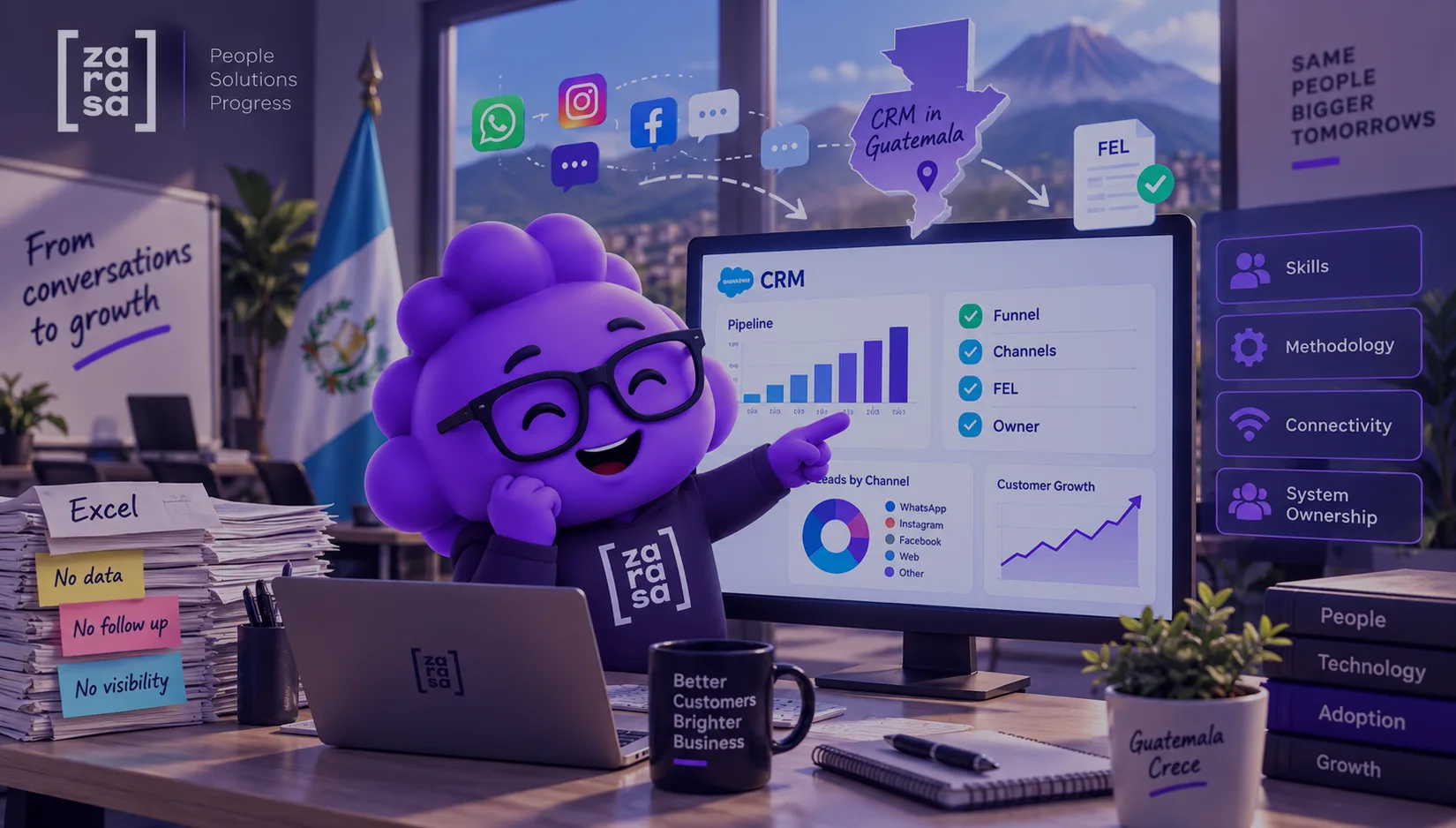

Let us start with the uncomfortable part: there is no official figure for how many Guatemalan companies use a CRM. Neither the Chamber of Industry, nor the Chamber of Commerce, nor the national statistics institute, nor the Ministry of Economy, nor the IDB nor ECLAC has measured it. Any article that gives you a round percentage for "CRM adoption in Guatemala" either made it up or copied it from another country's survey. We implement Salesforce in Guatemala from our own office in Mixco, and we do not know it precisely either.
What does exist is a set of indirect indicators, each with a source and a date, that draw the picture reasonably well: how many companies there are and how big, how many sell through digital channels, how many have a technology strategy, what holds them back, and what regulation forces. That is the material of this article. Where a figure is regional rather than Guatemalan, we say so.
The number that does not exist, and the closest one
The only regional study that measures CRM adoption by company size comes from ECLAC, with 2018 and 2019 data, and its CRM figure is for Chile: 5% of MSMEs and 21% of large companies used a CRM, against 22% and 77% using an ERP (ECLAC, 2021, pages 17 and 28). Chile is the most digitized country in the region on almost every index, so for Guatemala those numbers should be read as a ceiling, not an average.
The gap between ERP and CRM is the figure that interests us most: companies organize accounting and inventory first, because the law forces them to, and customer relationships much later, because nobody forces them. In Guatemala, as we will see, the law has just forced the first part.
Who buys: Guatemala's business landscape
According to the Ministry of Economy's National MSME Policy 2024-2032, in 2023 Guatemala had 218,426 MSMEs, 98.87% of all companies: 176,619 micro, 35,922 small and 5,885 medium-sized, against 2,477 large companies. They grew 32.7% since 2018, and 88.7% were born as an alternative to the lack of formal employment (IIES-USAC, May 2025, with Ministry data). MSMEs generate at least 40% of GDP and about 70% of employment (Ministry of Economy, 2025), and only 13% have obtained formal credit (AGN, July 2025).
For the CRM market, the relevant number is not the 218,000 MSMEs: it is the 5,885 medium-sized and 2,477 large companies. That is where you find a sales team, more than one sales channel and a real follow-up problem. It is a market of roughly 8,000 companies, and most of them still do not have a CRM. That is, with all its imprecision, our reading after four years of projects in the country.
What we do know: they sell digitally, without a system
The available digitization studies tell a consistent story, even though none of them mentions CRM by name.
In 2021, a Transformatec study with BAC Credomatic and the IDB, based on 60 interviews and 300 diagnostics, found that 71% of Guatemalan SMBs had no digital strategy, although 85% acknowledged needing one; that 62% said their staff lacked basic technology skills; that 75% did not measure customer satisfaction with digital tools and 55% used no indicators at all (Prensa Libre). The same study measured the other side: eight out of ten companies sold online through social networks (Facebook, Instagram, WhatsApp, Messenger) and six out of ten got more than half of their sales through digital channels (Prensa Libre).
Read them together: most sell through WhatsApp and social networks, and most measure nothing. That is, precisely, a sales operation without a CRM. The conversations live on the salespeople's phones, the closed deals in a spreadsheet, and the lost customers nowhere.
In 2022, a Microsoft study of 320 Central American MSMEs found that in Guatemala 72% had computers, 53% had video-call software and 38% used the cloud; 98% believed the pandemic had accelerated their digital transformation, and 48% named connectivity as a barrier (Microsoft, April 2022). A modern CRM is cloud software: that 38% was the ceiling for adopting one in 2022.
The most recent data is about e-commerce. ICEX's 2025 country report, using GRECOM and Ministry of Economy data, indicates that more than 35% of medium and large companies use digital channels to buy goods and services, against under 15% in 2019, and that about 25% of exporters sell through electronic platforms (ICEX, 2025). The Chamber of Commerce's seventh National E-commerce Study, from June 2026, found that 37.4% of the digital target population buys online, and that the main channel is still social networks, at 45.8%, ahead of websites at 38.3% (Guatemalan Chamber of Commerce, 2026).
The same signal again: the Guatemalan customer buys through social networks before websites. A company that wants to follow up on those sales needs WhatsApp, Instagram and Messenger to flow into one place.
Where we see adoption: the sectors that already did it
Since there are no statistics by sector, what we can add is what we have seen. The projects we delivered in Guatemala are on our country page, anonymized for confidentiality, and they show the pattern: a healthcare company processing medical claims that needed full traceability with queues, approvals and response times; a manufacturing and retail group with B2B and B2C channels integrated with SAP and a portal for its stores; a pharmaceutical company that digitized its medical reps with routes, per-rep inventory and reporting; and a tourism company that integrated its receivables with the bank, with the tax authority's electronic invoicing (FEL) and with the central bank's exchange rate.
The best-documented public case in the country is not a Salesforce one: Toyota Guatemala implemented HubSpot with the agency MAS Digital and reported 28% more lead generation and triple the sales from its website (PrensarioHub, 2022). We cite it because it is the evidence available, and because the pattern repeats regardless of brand: adoption starts in sectors with many transactions, several channels and a product that is complex to sell: healthcare, lenders and insurers, distribution, automotive, pharmaceutical, real estate and tourism.
The regulation that pushes, and the one that is missing
Two rules shape any CRM project in Guatemala, one because it exists and one because it does not.
Electronic invoicing (FEL) from the tax authority, SAT, has been mandatory for all taxpayers since June 1, 2023; pre-printed invoices stopped being valid on that date, and Decree 31-2024 added five electronic tax documents in force since April 2025 (Seres). For a CRM this means two things: every company already has an FEL certifier and a digital invoicing flow, so the ground is prepared; and any CRM that produces quotes or closes sales has to integrate with that certifier. We did it in the tourism project mentioned above, and it is one of the first questions we ask in any diagnosis in the country.
There is no personal data protection law yet. Two bills sit in Congress: 6464, filed in October 2024 and still under review by the National Security Committee in July 2026 (Emisoras Unidas), and 6572, modeled on the European regulation, with rights of access, rectification, erasure and objection (bill text). ICEX's report names the absence of data and e-commerce laws as a legal certainty barrier. Our recommendation is not to wait: design the CRM as if the law were already in force, with recorded consent, protected sensitive fields and the ability to erase a customer who asks. When it passes, and it will, the company that did so has nothing to redo.
What holds the rest back
Barriers are better documented than adoption. In 2021, 62% of SMBs said their staff lacked basic technology skills and 73% had no methodology for technology projects; 58% lacked basic computer equipment and 10.7% allocated no budget to innovation (Transformatec, cited above). 48% named connectivity as a barrier in 2022 (Microsoft). Only 13% of MSMEs access formal credit (AGN). And context weighs: 77% of companies compete with informal firms, according to the World Bank's 2017 survey (Enterprise Surveys), and labor informality stood at 65.6% in the fourth quarter of 2025 (INE, ENEIC).
ECLAC sums up the cost barrier in a sentence that applies to the whole region: solutions were designed "for and by large companies" and the investment is an "insurmountable barrier for SMBs". That is true for part of the market. It is also true that today there are CRMs that cost less than a phone per month; we compare three in Bitrix24 vs Zoho vs Salesforce. License cost stopped being the main barrier. The barrier is the talent to implement it and the discipline to use it.
Where to start if you are one of the 8,000
If your company is medium-sized or large, sells through WhatsApp and social networks, already invoices through FEL and still tracks follow-up in spreadsheets, the sequence we have seen work is short.
First, a single funnel. Before choosing a brand, write down the stages of a sale and what information is captured at each one. It is what the 55% who use no indicators do not have, and no software solves it on its own.
Second, the channels inside the system. WhatsApp, Instagram and Messenger must create the contact and the opportunity without anyone copying them by hand. If the tool does not do it, the team will keep selling from their phones.
Third, FEL from day one. The approved quote has to become an invoice without retyping. It is the integration that saves the most time and avoids the most errors.
Fourth, someone inside who owns the system. An administrator, even part-time, trained on the real configuration. The project without an owner is the one that goes back to the spreadsheet within two years.
We work with Guatemalan companies from Mixco and can start with the diagnosis. But the order above holds just as well if you choose another tool or another partner.
Frequently asked questions
What percentage of companies in Guatemala use a CRM?
There is no official figure. No Guatemalan or international body has measured it. The closest regional reference is ECLAC's figure for Chile, with 2018-2019 data: 5% of MSMEs and 21% of large companies. For Guatemala it should be read as a ceiling.
How many medium and large companies are there in Guatemala?
According to the Ministry of Economy's National MSME Policy 2024-2032, in 2023 there were 5,885 medium-sized and 2,477 large companies, plus 176,619 micro and 35,922 small businesses. MSMEs are 98.87% of the total and generate at least 40% of GDP.
Which channel do Guatemalan SMBs sell through?
Social networks and messaging. In 2021, eight out of ten sold through Facebook, Instagram, WhatsApp or Messenger, and six out of ten got more than half of their sales through digital channels. In 2026, 45.8% of online purchases happen through social networks, ahead of websites.
Does electronic invoicing affect the choice of a CRM?
Yes. SAT's FEL has been mandatory for all taxpayers since June 1, 2023. Any CRM that produces quotes or closes sales must integrate with the FEL certifier so the approved quote becomes an invoice without re-entering it.
Does Guatemala have a personal data protection law?
Not yet. Two bills, 6464 and 6572, are in Congress without approval as of September 2026. We recommend designing the CRM as if the law were already in force: recorded consent, protected sensitive data and the ability to erase a customer who asks.
What is the main barrier to adopting a CRM in Guatemala?
Based on the available data, talent and discipline more than cost. In 2021, 62% of SMBs said their staff lacked basic technology skills and 73% had no methodology for technology projects. Very cheap CRM licenses exist today; what is missing is who implements and who maintains them.