

Customers start to delegate
On October 19, 2026, Salesforce published an analysis in its newsroom with a counterintuitive thesis: personal AI agents will drive more contact center traffic, not less (Salesforce).
The idea is simple. If a consumer asks their assistant to cancel a subscription or find out where an order is, the assistant needs the business on the other side to do something. So it gets in touch.
Until now, we have designed customer service for people: phone menus, security questions, business hours, satisfaction surveys. This article looks at what happens when the caller is no longer a person but an agent acting on their behalf. It is an opinion piece about something that is only starting, so we keep what the sources say apart from our own reading.
Why there will be more contacts, not fewer
Gartner has been anticipating this for years under the name machine customers. In 2023 it predicted that by 2026, 20% of inbound customer service contact volume would come from machine customers (Gartner, 2023). In March 2025 it went further: service teams will have to handle a growing number of machine customers, and both customers and organizations will use this technology to automate interactions (Gartner, 2025).
The Salesforce analysis adds three reasons volume may go up:
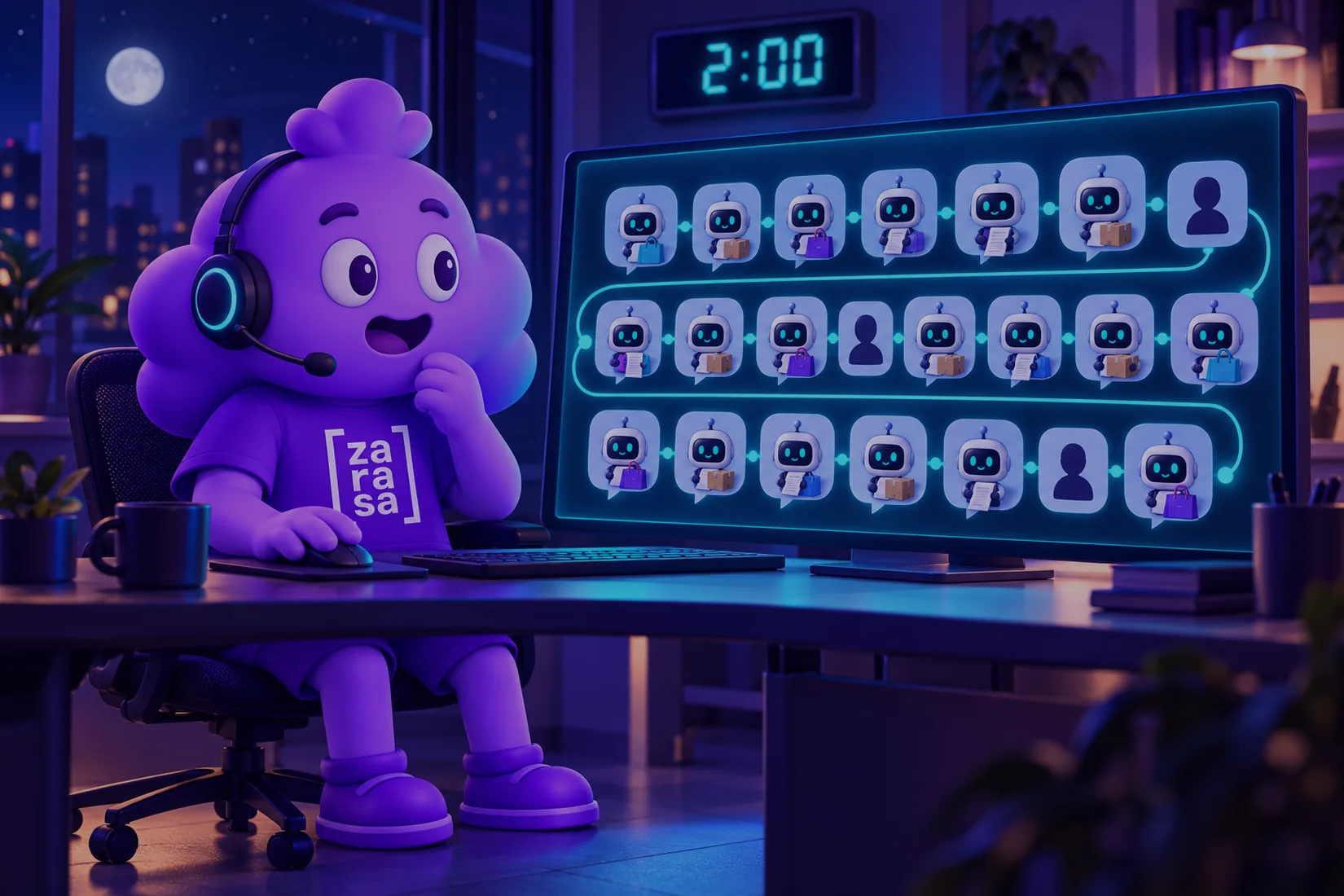
- An agent never gets tired of waiting. It can check an order's status every few hours or call at 2 a.m., which almost no person does.
- Many tasks don't resolve themselves. A personal agent doesn't have the customer's history with the business or know its internal processes, so it needs someone on the other side to finish the job.
- Voice is the most expensive channel. If some of those agents call by phone, cost grows in the channel that already weighs most on the budget.
Salesforce's own text warns that volume could become “astronomical.” That is a projection, not a measurement. But the logic holds: when handing off a task costs the customer nothing, the customer hands off more tasks.
What breaks in service built for people
This is our own reading, based on how the service operations we see across the region are set up. At least five pieces assume there is a person on the other end.
Phone menus
A “press 1, press 2” menu exists to sort people. For an agent it is a slow obstacle it has to walk through on every single contact.
Identity verification
Security questions check that the caller is the account holder. With an agent, the question changes: it is no longer who is speaking, but whether they have the holder's authorization to do this.
Staffing
Teams are sized around human peaks: mornings, lunchtime, Mondays. Agents don't follow that calendar.
Metrics
Average handle time and satisfaction surveys measure a person's experience. An agent doesn't fill in surveys, and its owner cares about one thing: whether the issue got resolved.
Retention scripts
The offer that keeps a customer from cancelling is written to persuade a person. An agent told to “cancel” probably won't be persuaded, although it could pass the offer on to its owner.
The answer: a business agent with context
Salesforce's recommendation is to meet those agents with agents of your own: business agents that know the processes, have access to customer data and can resolve the request end to end, with a person available for what can't be automated. It is a self-interested recommendation, since Salesforce sells that technology. But the alternative has an obvious cost problem: answering a flood of agents with a queue of people.
Two announcements from the same week show where that infrastructure is heading:
- Shared context. On October 20, Salesforce introduced the Agent Context Engine, still in preview: a layer that assembles the customer's context for each agent (profile, history, real-time signals), filtered by that agent's permissions. Its core argument is that the problem with agents isn't data, it's context (Salesforce).
- Voice. On October 19, Salesforce AI Research introduced Launa-Omni, a voice model for real-time conversation. On a benchmark of retail, airline and telecom customer service tasks it scored 72.9% (Salesforce AI Research). The post doesn't say which languages it supports.
The practical takeaway doesn't depend on any vendor: in a conversation between two agents, the one with better context wins. The customer's agent knows what the customer wants. The business's agent has to know everything else.
The problem: many business agents are still in pilot
This is where the pitch meets reality. According to a 10K report cited by Salesforce Ben, 85% of surveyed customers have tried or deployed Agentforce, but almost half are still in testing or pilot. In the 2026 Salesforce Admin Survey, 30.4% named Agentforce one of their lowest-confidence areas (Salesforce Ben).
The causes the report lists are familiar to anyone who implements: going from an agent that works in a demo to one that works in production, proving value, justifying cost and getting systems ready. Our experience adds one more, and it is the biggest blocker: messy data and poorly defined permissions. An agent that doesn't know what it can see or what it can change never leaves the pilot.
We told one of our own cases, self-criticism first, in Failing with flying colours.
Five questions for your service operation
Before your customers’ agents show up
- Can you tell when there is an agent on the other side? Without that, you can't measure it or give it its own path.
- How do you verify it is acting with the account holder’s authorization? For example, by confirming sensitive operations with the customer through a channel they control.
- Which of your ten most frequent contact reasons can be resolved without a person? Those are the first ones that will arrive through agents.
- Does your service agent have the full history and the right permissions? If not, it will end up escalating everything.
- Do you measure resolution or handle time? With agents on the other side, what counts is whether the issue was resolved.
What it means for Latin America
In much of the region, customer service runs on WhatsApp. It is reasonable to expect personal agents to write there too, in the same channel where businesses serve people today. That is our reading, not a data point: there are no public measurements of this in Latin America yet.
What we do see in projects is that many businesses in the region run service processes that depend on people who know the system “by heart.” That knowledge is exactly what a business agent needs written down, organized and accessible. Companies that do that work now will be able to serve their customers’ agents with agents of their own. Those that don’t will serve them with more people.
Where to start
- Measure before you decide. Identify your most frequent contact reasons and what each one costs to handle, by channel.
- Pick a few requests and resolve them end to end. An agent that fully resolves three requests is worth more than one that answers questions about twenty.
- Fix data and permissions first. It is the least visible work and the one that decides whether the agent leaves the pilot.
- Define when a person steps in. And make sure the handoff carries the context, so nobody has to repeat anything.
- Change your metrics. Resolution, cost per resolved contact and escalations, rather than average handle time.
If your operation runs on Salesforce, our Agentforce implementation page explains how we work through those steps, and Agentforce pricing breaks down the Flex Credits consumption model.
Is your service ready for customers that aren’t people?
Zarasa is a Salesforce Partner with offices in Miami, Mexico City, Mixco and Montevideo. We review your service operation in a free 45-minute assessment.
Talk to us →Frequently asked questions
What is a machine customer?
It is Gartner's term for a device or piece of software that acts as a customer: it negotiates, buys or requests service on behalf of a person or a company. An AI agent that contacts a business to file a complaint for its owner is one example.
Will AI agents reduce calls to contact centers?
Not necessarily. Salesforce argues that personal agents will increase traffic, because they can contact businesses more often and at any hour, and many tasks still need the business to step in. That is a projection, not a measurement.
How do I know if an AI agent is contacting me?
There is no single standard yet. Some agents identify themselves; others can be spotted by their contact pattern: frequency, time of day and how messages are structured. It is worth starting to log it so you can measure how much it weighs on your operation.
What does a business need to serve AI agents?
Processes that can be resolved end to end without a person, clean customer data, clear permissions on what each agent can see and do, a way to verify the agent is acting with the account holder's authorization, and a handoff to a person with full context.
Why do so many AI agent projects stay stuck in pilot?
According to a 10K report cited by Salesforce Ben, almost half of the customers who tried or deployed Agentforce are still in testing or pilot. The reasons it lists are getting the agent into production, proving value, justifying cost and getting systems ready. In our experience, the most common blocker is data and permissions.